
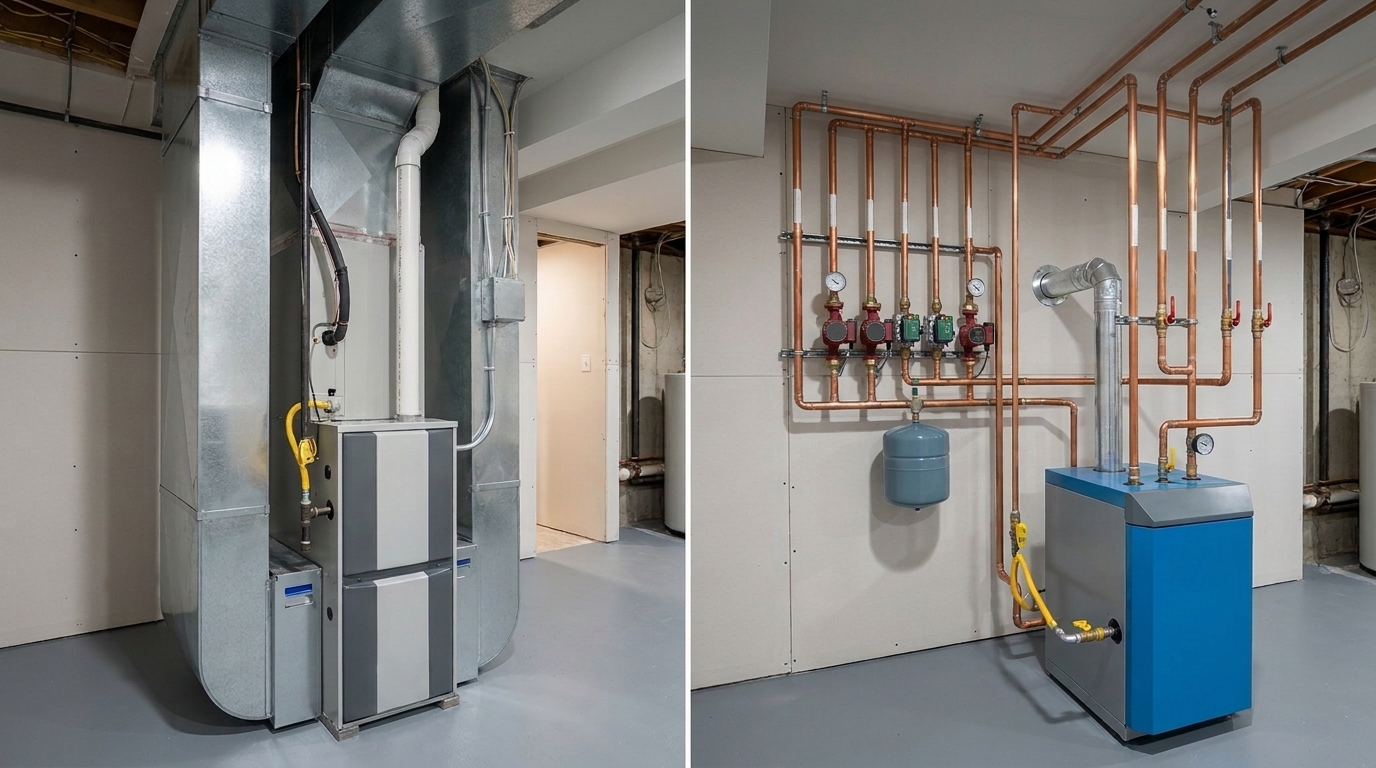
In a boiler vs furnace decision, the better choice usually depends on the heating system your Westchester home already has. A home with radiators, hot-water baseboards, and usable hydronic piping may be a natural fit for another boiler. A home with ductwork that already serves heating and central air may be better suited to a furnace.
Neither system is automatically better for every house. The more useful question is whether your existing distribution system still works well, what would have to change if you switched, and how your heating choice fits with the rest of your home’s comfort system.
The Difference That Matters Most
A boiler and furnace do the same basic job differently.
A boiler heats water and sends that heat through pipes to radiators, baseboards, or other hydronic equipment. Some older systems use steam. When comparing replacement equipment, homeowners can also review ENERGY STAR guidance on boiler efficiency to understand how modern boilers are rated.
A furnace heats air and uses a blower and ductwork to distribute that air throughout the home. ENERGY STAR’s furnace guidance is also useful when comparing the efficiency of newer equipment.
When comparing new equipment, efficiency should also be evaluated by the specific model rather than assuming one heating type is automatically more efficient. The U.S. Department of Energy uses AFUE as a standard measure of furnace and boiler heating efficiency.
| If your home already has… | Usually worth considering first |
| Radiators or hot-water baseboards | Another boiler |
| Ductwork serving heat and central AC | Another furnace |
| A distribution system in poor condition | Evaluate the equipment and distribution together |
| A major renovation underway | Compare several heating options |
| Persistent comfort problems | Diagnose the cause before choosing equipment |
Why Westchester Homes Do Not Have One Clear Winner
Westchester County has a wide variety of housing, including a significant number of older homes, particularly in southern communities.
That matters because many older houses were built around heating systems that are still part of the home’s structure. Some have radiators or baseboard heat. Others have been updated over the years with ductwork, central air, ductless equipment, additions, or a mix of different systems.
There is not a reliable public countywide count showing whether boilers or furnaces are more common across Westchester. More importantly, that number would not tell you what is right for your house.
For a homeowner in New Rochelle or elsewhere in Westchester, the condition and layout of the existing system usually matter far more than which type of equipment is more popular overall.
Start With What Your Home Already Has
If You Already Have Radiators or Baseboards
If your boiler is aging but the piping, radiators, or hot-water baseboards are still working well, boiler replacement may be the most straightforward option.
An old boiler does not automatically mean the entire heating approach is outdated. Switching to forced-air heat could require new ductwork, and finding room for ducts in an older finished home can add cost, disruption, and design challenges.
A boiler may be worth staying with when:
- The hydronic distribution system is still in good condition
- Heat is generally comfortable and even
- Your cooling system already works separately
- Adding ductwork would require substantial remodeling
If You Already Have Ductwork
A furnace often makes sense when your home already has properly designed ductwork, especially if those same ducts also distribute central air conditioning.
The advantage is not simply the furnace itself. It is that the home already has a usable pathway for moving conditioned air.
Before replacing a furnace, however, the ductwork should still be considered. A new furnace installation will not fix leaking ducts, correct poor airflow, undersized returns, or rooms that never seem to get enough heat.
If You Are Already Renovating
A major renovation can change the decision.
If walls and ceilings are already open, or the existing heating distribution system needs major work, it may be more practical to compare different approaches rather than automatically replacing like-for-like.
That could include a boiler, furnace, heat pump, or a combination of systems depending on the home’s layout and goals.
Before Switching, Think Beyond the Heating Equipment
Changing from a boiler to a furnace, or from a furnace to a boiler, is not just an equipment swap.
Before making that decision, consider:
- Distribution: Would you need new ducts, piping, radiators, or baseboards?
- Cooling: Does your current AC rely on the same ductwork as your furnace?
- Comfort: Are you replacing the system because it is old, or because certain rooms are uncomfortable?
- Installation disruption: Would switching systems require opening finished walls or ceilings?
- Existing condition: Are the ducts or hydronic components still worth keeping?
- Long-term plans: Are you staying in the home, renovating it, or changing how different floors are used?
This is where a simple boiler vs furnace comparison can become misleading.
The condition of the heating equipment is only part of the decision. With a boiler, the piping, circulators, radiators, and baseboards matter. With a furnace, the ductwork and airflow matter.
Replacing the equipment without evaluating the distribution system can leave you with the same comfort problem and a brand-new heater.
A Better Boiler vs. Furnace Decision Checklist
Before choosing one system over the other, ask:
- What type of heating distribution does my home already have?
- Is that distribution system still in good condition?
- Does my heating system share equipment or ductwork with my cooling system?
- Am I replacing equipment because of age, repeated repairs, poor comfort, or efficiency concerns?
- What would physically have to change in the house if I switched system types?
- Would the money spent converting solve a problem I actually have?
If your existing system works well apart from aging equipment, staying with the same heating approach may make sense. If the distribution system itself is part of the problem, the decision deserves a broader look.
Boiler vs. Furnace FAQs
Can I have a boiler and central air conditioning?
Yes. Many homes use a boiler for heating and a separate central air conditioning or ductless system for cooling. The two systems do not have to use the same distribution method.
Which system usually lasts longer?
Service life varies based on the equipment, installation quality, maintenance, operating conditions, and how heavily the system is used. Age alone is not enough to determine whether a boiler or furnace should be replaced.
Does a furnace make indoor air drier than a boiler?
Not necessarily. Indoor air often becomes dry in winter because cold outdoor air contains relatively little moisture once it is heated indoors. Forced-air movement may make dryness more noticeable to some people, but the furnace itself is not always the underlying cause.
Can I replace an old boiler with a heat pump instead?
Possibly. Heat pumps are another option, but the decision depends on the home’s heating load, electrical capacity, layout, insulation, existing distribution system, and the type of heat pump being considered.
Should I replace my heater just because it is old?
Not automatically. Reliability, repair history, efficiency, safety, comfort, and the cost of upcoming repairs are more useful factors than age alone.
Which Heating System Makes Sense for Your Westchester Home?
There is no universal winner in the boiler vs furnace comparison. A boiler can remain an excellent fit for a Westchester home built around hydronic heat, while a furnace may be the more practical choice when good ductwork is already serving the house.
Before changing heating types, look at the entire system, not just the equipment in the basement or mechanical room. The best choice should account for comfort, installation scope, cooling, existing infrastructure, and what you actually want to improve.
If your boiler or furnace is nearing replacement and you are unsure whether to stay with the same system or consider a different approach, contact G.C. Reliable Service for an evaluation of your home’s heating setup before making the investment.